
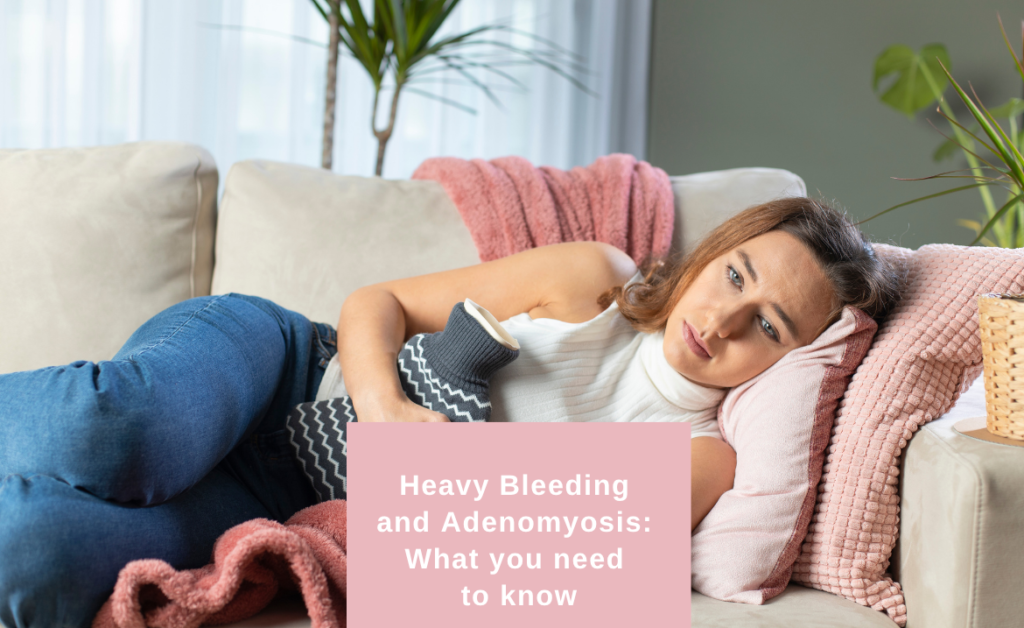
Have you been told for years that your periods are simply “bad?” The truth is, it may be more than just a ‘bad’ period. Heavy bleeding is often a sign of Adenomyosis.
Every month, the severe, stabbing cramps and heavy bleeding arrive like a storm. Soaking through clothes, disrupting meetings, stealing sleep, and leaving you bent over in pain and exhausted before the day has even begun. Sound familiar?
Many women are told that it’s normal, by doctors, mothers and even friends. You often find yourself wondering if this was just part of being a woman, something you must endure in silence.
So, what is really happening and could it be adenomyosis?
What is Adenomyosis?
Adenomyosis is often dubbed the evil twin of endometriosis.
In endometriosis, the endometrial tissue grows outside the uterus. But in adenomyosis, the tissue embeds deep into the uterine muscle wall, which causes your uterus to thicken and enlarge. As the muscle gets inflamed and irritated, it causes pain, pressure, and heavy periods. You feel like your uterus is angry all the time and won’t let you forget it.
It can feel like it is controlling your life. You might sometimes find yourself questioning if this is all in your head. But remember, it’s not. In Australia, 1 in 5 females, aged between 30 and 50, have adenomyosis.
Symptoms and signs to watch out for
You probably already have the gist of the debilitating, life-sucking symptoms one endures every month like clockwork, but here’s a refresher. And before we list them, it’s important to know that every woman will have the same symptoms, and some may never have any.
Without further ado, take a pen and paper or a diary and note down if you have any of the following:
- Painful menstrual cramps
- Heavy menstrual bleeding
- Pelvic pain
- Painful intercourse
- Infertility
- Enlarged uterus
- Bloating
- Painful sex (dyspareunia)
- Iron deficiency due to heavy periods
If you or anyone you know thinks they may have adenomyosis, you must get in touch with your health provider.
The important lesson to carry with you is this: heavy periods should never be dismissed when they are changing your life.
Diagnosis and treatment for adenomyosis
Hats off to you for taking action to get some answers and a possible solution.
This is not a one-size-fits-all journey. Diagnosis and treatment will depend on your individual circumstances.
Diagnostic tests
- Pelvic exam – A pelvic exam may be carried out to see if your uterus has gotten larger or is painful to touch.
- Ultrasound – Your specialist will use a transvaginal ultrasound to determine if there is a thickening of your uterine wall.
- MRI scans – Your doctor may recommend an MRI scan. This can allow your healthcare provider to get a closer look at certain areas of your uterus and any thickening or enlargement that may be present.
Management and Treatment Options
He’s the truth: there is no cure for adenomyosis. But don’t be disheartened. The good news is it’s not all doom and gloom. Based on your diagnosis, your specialist may recommend management options such as:
- Pain medications – This includes Nonsteroidal anti-inflammatory drugs (NSAIDs), such as ibuprofen or Advil.
- Hormonal medications – Options such as birth control pills and hormonal intrauterine devices (IUDs) can help manage heavy menstruation.
In some circumstances, your doctor may recommend surgery. These include:
- Adenomyomectomy – The surgery involves removing the adenomyosis from your uterine muscle.
- Hysterectomy – During this surgery, your specialist will remove your uterus. A hysterectomy is often the very last option.
Many of you may have heard older women say, ‘It gets better with time.’ This is because, as you approach menopause, you may find that symptoms fade naturally. However, you do not need to suffer in the hope that one day the pain will stop.
It’s time to take action.
If there is one thing we would say to every woman silently struggling with heavy bleeding, it would be this: please do not wait for your pain to become unbearable before you seek help. If your period is excessively heavy, lasts too long, causes severe cramps, or leaves you drained and anxious, speak to a healthcare professional and ask whether it could be adenomyosis.
You deserve answers, treatment, and relief. Your body is not overreacting, and you are not being dramatic.
Take the next step today. Book an appointment with our team to get the answers, treatment and care you need.
In the meantime, track your symptoms and advocate for the care you need. The sooner you act, the sooner you can move from simply surviving your cycle to reclaiming your life.