
This post was originally published on 16th March 2024 and updated on 23rd March 2026
So, you’ve been diagnosed with Endometriosis. What now? With all the questions mulling in your mind, one of the key questions and conversations you’ll come across is: What are the treatment options available?
To answer those questions, in this article, we shed light on how endometriosis is treated using robotic surgery here at Wollongong Obstetrics and Gynaecology. But first, it is important to refresh your knowledge on the basics.
What is Endometriosis?
Endometriosis is a condition in which endometrial tissue that lines the uterus grows outside the uterus, eventually shedding into the abdominal cavity, causing chronic pain, abnormal periods and/or infertility.
According to the Australian Institute of Health and Welfare, 1 in 7 (14%) women in Australia are diagnosed with Endometriosis by the age of 44-49, with an estimate of 8.8% between the ages of 26-31 being diagnosed.
While there is currently no cure for endometriosis, there are ways in which we can treat it, including:
- hormonal and non-hormonal medication to manage pain and reduce oestrogen levels,
- alternative medications and treatments, such as physiotherapy and psychology, as a form of supportive treatment, and
- surgical treatments such as laparoscopic or robotic surgery.
Before proceeding with any form of treatment, your specialist will discuss the options available to suit your circumstances.
Is surgical treatment necessary?
We understand that the thought of surgical treatment can be daunting. But in some cases, this is the only solution and the only way to be sure that the cause of your symptoms is, in fact, endometriosis.
The main types of surgery may include:
- Endometriosis resection: to remove endometriosis patches.
- Hysterectomy: to remove the uterus and possibly nearby organs.
Robotic surgery for endometriosis
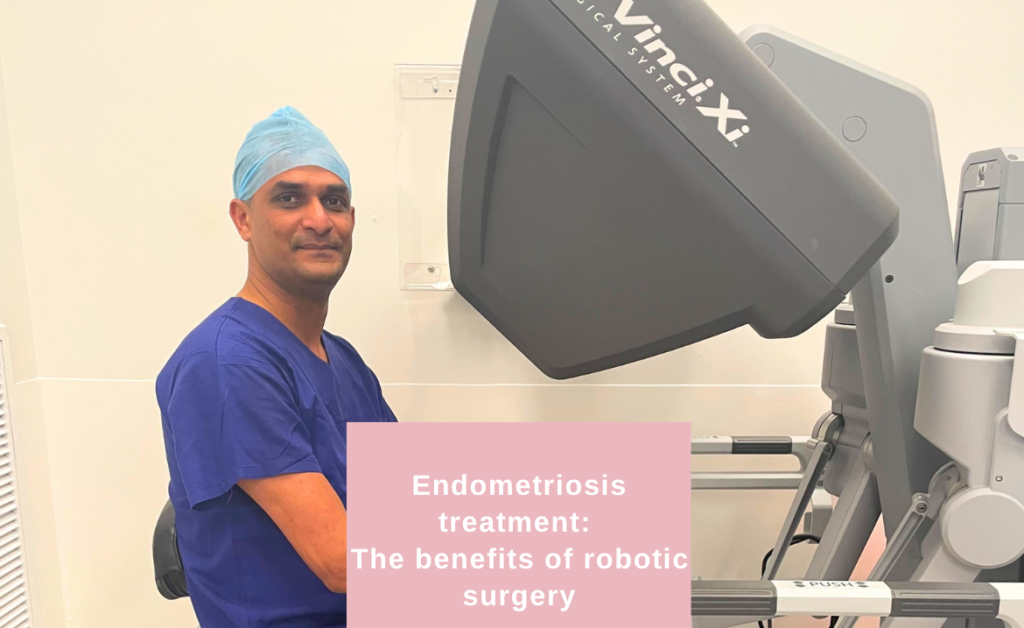
While there are two minimally invasive approaches: Laparoscopic surgery and robotic surgery, here at Wollongong Obstetrics and Gynaecology, Dr Kothari uses Da Vinci technology when performing robotic-assisted endometriosis surgery.
- In this method, the doctor sits at a console next to you and operates using tiny, fully wristed instruments.
- A camera provides a high-definition, 3D view of the inside of your body.
- The Da Vinci system translates every hand movement in real time, enabling precise operation.
Whether your specialist will suggest robotic surgery for you will depend on several factors, including:
- the procedure you are having,
- your overall health and
- if it is the best approach for you.
Dr Kothari will carefully consider the best approach for you after thoroughly investigating your circumstances. He will take the time to discuss the details and technique he will perform before scheduling your surgery.
What are the benefits of robotic surgery?
If you’re still feeling nervous at the thought of surgery, here are some benefits of robotic surgery to ease the tension.
- Like laparoscopic surgery, robotic surgery uses small incisions, which means the recovery period is usually faster and more comfortable, allowing patients to get back to their regular routines quickly.
- Less risk of infections.
- Lower risk of complications.
- Less pain and discomfort while recovering.
- Reduced risk of blood loss.
- Incisions are so small that they are often closed with surgical adhesives and covered with small bandages.
Will I need to stay in the hospital?
The last thing you need is a long hospital stay. And the good news (based on your circumstances) is that Robotic Surgery treatment is usually conducted on an outpatient basis. Thus, you can return home the same day. Your doctor will let you know if you need to stay in the hospital longer.
Why choose Dr Kothari for robotic surgery?
Dr Kothari is the first and leading gynaecologist to use da Vinci robotic-assisted techniques in the Illawarra. He is the most sought-after expert in the field.
End the pain – book an appointment today
Are you or anyone you know suffering from endometriosis? Are you considering surgical treatment but are unsure? Give our team a call on 02 4225 1999 to book an appointment and have your questions answered.
In the meantime, here are some resources to guide and support you.